
Question
Question: 4fx²-(m-3)x+m≥0 (m∈R) Find 'm' if (i) Both roots are +ve. (ii) Both roots are -ve. (iii) Roots are o...
4fx²-(m-3)x+m≥0 (m∈R) Find 'm' if (i) Both roots are +ve. (ii) Both roots are -ve. (iii) Roots are of opposite sign. (iv) Atleast one root is +ve. (v) Atleast one root is -ve.
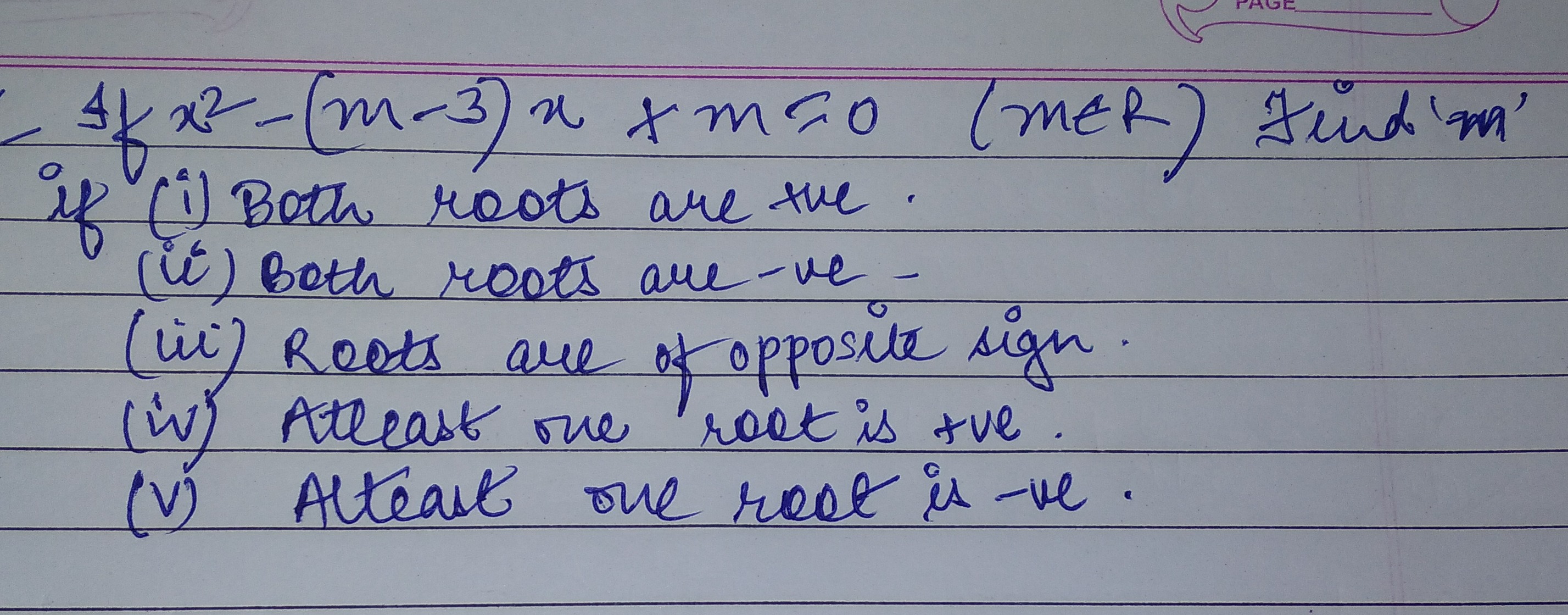
(i) Both roots are +ve: m∈[11+47,∞)
(ii) Both roots are -ve: m∈(0,11−47]
(iii) Roots are of opposite sign: m∈(−∞,0)
(iv) Atleast one root is +ve: m∈(−∞,0)∪[11+47,∞)
(v) Atleast one root is -ve: m∈(−∞,11−47]
(i) Both roots are +ve: m∈[11+47,∞) (ii) Both roots are -ve: m∈(0,11−47] (iii) Roots are of opposite sign: m∈(−∞,0) (iv) Atleast one root is +ve: m∈(−∞,0)∪[11+47,∞) (v) Atleast one root is -ve: m∈(−∞,11−47]
Solution
The conditions for the nature of roots of a quadratic equation ax2+bx+c=0 are determined by its discriminant (Δ=b2−4ac), sum of roots (S=−b/a), and product of roots (P=c/a). For real roots, Δ≥0.
- Both roots positive: Δ≥0,S>0,P>0.
- Both roots negative: Δ≥0,S<0,P>0.
- Roots of opposite sign: P<0 (implies Δ>0).
- At least one root positive: (roots of opposite sign) OR (both roots positive).
- At least one root negative: (roots of opposite sign) OR (both roots negative or zero, and at least one strictly negative). Applying these conditions to 4x2−(m−3)x+m=0 with a=4,b=−(m−3),c=m, we find Δ=m2−22m+9, S=(m−3)/4, P=m/4. Solving the inequalities for m yields the respective intervals.